


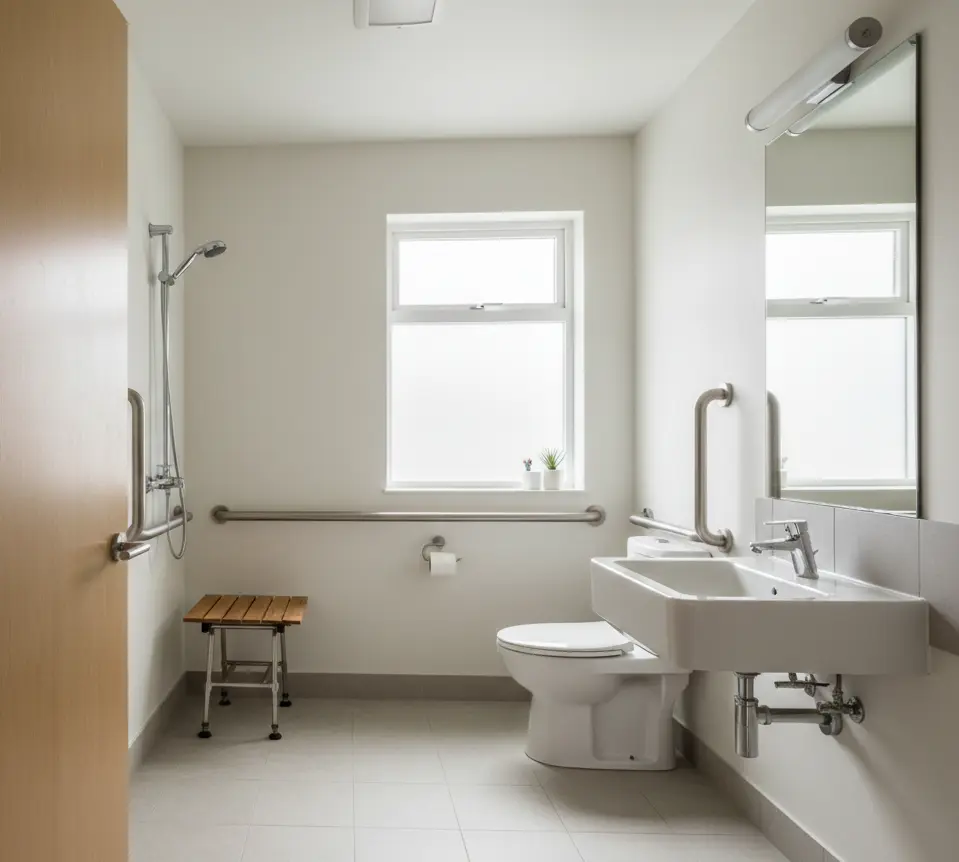
When people search “ADA restroom guidelines”, they usually want one of two things:
- Exact bathroom dimensions they can measure (so they don’t fail an inspection or waste money).
- A clear plan for how to remodel an accessible bathroom without getting lost in legalese.
That’s exactly how I’m going to cover it here practical, measurement-first, and remodel-friendly plus a Texas veteran angle at the end, because that’s often the real “why” behind the project.
What “ADA Restroom Guidelines” Actually Mean (and Which Standards Apply)
“ADA restroom guidelines” is a shortcut phrase people use for the ADA Standards for Accessible Design. ADA.gov is essentially the “official hub” that points you to the standards and related guidance, while the U.S. Access Board provides very technical guidance (including how toilet rooms are laid out and measured).
Here’s the part homeowners and business owners miss: ADA standards are extremely specific, but your project’s scope changes what’s required and how strict things get. A new build or major renovation is very different from a smaller alteration. That’s why two people can both say “I did an ADA bathroom” and still end up with totally different layouts.
In my experience, most headaches happen when someone tries to “wing it” with a few dimensions from a blog post. You get 80% right, then fail on something that feels small like how the door swing interacts with clearance spaces, or where a clearance can overlap and where it can’t. That’s why I like to treat ADA bathroom work like a mini set of construction documents: measure, sketch, verify, then build.
Also, quick reality check: ADA compliance isn’t just about being a good human (though it is). It can also affect:
- customer access and usability,
- inspections and remodel rework,
- and, for veterans, whether a home adaptation project moves smoothly through review and final inspection.
For this article, I’m focusing on the parts people actually search for:
- turning space
- toilet placement
- grab bars
- door/approach clearances
- and what those measurements mean in real remodel scenarios.
And yes because you told me the strategy up front I’m deliberately using both “guidelines” and “dimensions” language (informational intent), and then I’ll close with a practical path to getting the work done by a contractor who’s used to executing accessibility upgrades in Houston.
ADA Bathroom Dimensions You Can Measure Today (Quick Reference)
If you only read one section, read this one. These are the “high-frequency” measurements people look for when they search things like handicap bathroom size, handicap bathroom dimensions, or accessible bathroom.
Quick reference table (common requirements people measure)
| Item | Common ADA measurement people use |
| Turning space | 60″ diameter circle or a T-turn option |
| Toilet centerline (from side wall) | 16″–18″ |
| Toilet seat height | 17″–19″ (typical ADA range people cite) |
| Grab bar height | 33″–36″ (typical ADA range people cite) |
Turning space: 60″ circle (and why it changes the whole layout)
The 60-inch turning space is the big one because it quickly dictates whether a bathroom feels usable or “technically compliant but practically miserable.” In remodels, I like to start with turning space before I even think about tile selections or vanity styles. If the turning area is being pinched by a vanity depth, a door, or a weird corner, you can end up redesigning the entire room later.
Also, a big “gotcha”: some overlaps are allowed and some aren’t. Doors can often swing into turning space, but they generally can’t swing into certain required clear floor spaces for fixtures. This is one of the reasons I don’t recommend copying a random floor plan off the internet two bathrooms can look similar but behave totally differently once you account for approach and clearances.
Toilet placement: centerline matters more than people expect
That 16″–18″ centerline measurement is a classic failure point when someone shifts framing, adds furring, or changes wall finishes and doesn’t re-check the final dimension. In real remodels, that’s where I slow down and re-measure after rough-in but before everything gets closed up.
And this is where your keyword strategy makes sense: people aren’t searching “ADA” because they’re bored they’re searching because they want the remodel to be right the first time. If you’re planning a project for accessibility (especially with veteran-related home modification needs), this “measure early, measure again” approach saves serious time and money.
Grab Bars, Heights, and Real-World Installation Tips
Grab bars seem simple until you install them wrong. I’ve seen plenty of bathrooms that look accessible and still feel unsafe because the grab bar placement doesn’t match how people actually transfer, stand, or steady themselves.
Height (common range) and what people get wrong
A commonly referenced ADA grab bar mounting height is 33″–36″. That number is easy to repeat and easy to mess up in the field because:
- installers measure from the wrong baseline (finished floor vs subfloor),
- tile thickness changes the final dimension,
- or a design change happens late and nobody re-checks the layout.
I’m a big believer in marking these locations clearly during planning then validating after wall surfaces are finalized but before final install.
The #1 mistake: treating grab bars like towel bars
Grab bars must be installed so they can actually support load. Practically speaking, that means planning for proper backing and anchoring not hoping a hollow wall will “hold fine.” If you’re remodeling, backing is something you want planned during demo/rough framing so you’re not forced into awkward compromises later.
Placement is not just a number it’s a movement pattern
This is where “guidelines” become real life. A grab bar next to a toilet isn’t there to decorate the room it’s there to support a predictable movement: approach → transfer → stabilize → stand. So I like to think in “body mechanics,” not just inches.
And since your article strategy is aimed at people actively planning remodel work, here’s a practical tip I’ve learned the hard way: mock it up. Even a simple painter’s tape outline on the wall can reveal problems before you drill holes into finished tile.
This is also a good point to bring the veteran context in naturally: when a bathroom modification is being done for mobility needs, the difference between “close enough” and “installed correctly” isn’t cosmetic it’s safety and daily independence. That’s why I prefer working from a clear plan and verified measurements, not guesswork.
Single-User, Family/Unisex, and Multi-User Restrooms: Practical Layout Scenarios
ADA restroom layouts aren’t one-size-fits-all. A single-user restroom remodel (like in a small office or retail space) behaves differently than a multi-stall commercial bathroom. And if you’re adapting a home bathroom for accessibility, you’re basically living in a “single-user restroom” world just with residential constraints.
Single-user restrooms
Single-user rooms are often the most achievable to improve because you can control the whole space: door, toilet location, turning area, and accessories. The biggest limiter is usually square footage. If the room is too tight, it’s not about forcing a “compliant” layout into it it’s about deciding whether walls need to move, fixtures need to change, or a different bathroom should become the accessible one.
In my own planning mindset, I start by asking:
- Can we get the turning space without creating a door conflict?
- Can the toilet placement hit the centerline measurement without boxing ourselves into a corner?
- Can we add grab bars with proper backing?
Family/unisex style rooms
Unisex or family restrooms can be a great accessibility solution in commercial settings because you have privacy, space, and more flexibility. But they’re not a magic fix if the building still needs accessible routes and compliant facilities elsewhere. They’re best treated as a smart addition, not a loophole.
Multi-user restrooms
Multi-user restrooms introduce complexity quickly: stall sizing, approach clearances, and the relationship between fixtures and circulation space. This is where projects can get expensive if you don’t plan early, because shifting partitions and plumbing is rarely “minor.”
And here’s the real-world point: people searching handicap bathroom size often assume there’s one universal “stall size” that solves everything. In practice, layout success comes from coordinating turning space + fixture clearances + door behavior as one system.
If you’re remodeling and you want a result that feels genuinely accessible (not just “technically okay”), treat your layout like a workflow: someone needs to enter, close the door, turn, transfer, and exit comfortably. That’s the standard I’d hold the design to, especially when the remodel is meant to support long-term mobility needs.
ADA vs “Accessible Bathroom at Home”: What Homeowners (and Veterans) Should Know
This is where a lot of confusion lives, so I’ll say it plainly: ADA is primarily a public accommodations standard, but the design logic of ADA (clearances, reach, turning, support) is extremely useful for home accessibility planning.
So if you’re a homeowner searching “ADA restroom guidelines,” what you often really mean is:
- “I need an accessible bathroom that supports mobility safely.”
- “I’m planning a remodel and I want it done to recognized standards.”
- “I don’t want to redo work because something was measured wrong.”
In my case, I like to borrow the ADA measurement discipline (turning space, toilet centerline, grab bar heights) even in residential projects because it creates a repeatable, verifiable plan. That matters even more when the remodel is connected to veteran home adaptation needs because projects often involve documentation, reviews, and final inspections, and “almost right” can still become delays.
The remodel reality (what actually causes rework)
If I had to list the most common remodel pain points, they’d be:
- Door swing conflicts with required clearances
- Vanity depth stealing the turning area
- Toilet rough-in landing outside the intended centerline after finishes
- Grab bars added late without proper backing
- Last-minute fixture swaps that change dimensions
You can avoid most of these by doing two simple things:
- Measure and sketch the room before demo (even a basic scaled drawing helps).
- Re-verify measurements after rough-in (because that’s when mistakes are cheapest to fix).
And since your SEO strategy is intentional (dimensions + guidelines to attract informational intent), this is also where you earn trust: give people a clean checklist, show them what to verify, and don’t pretend accessibility is only about buying the “right” toilet.
Texas Veterans: Home Modification Grants and VA-Focused Accessible Bathroom Upgrades
If you’re a Texas veteran (or helping one) and the goal is an accessibility bathroom remodel, the “how” matters as much as the “what.” Because it’s not just about picking finishes it’s about getting a plan that can be reviewed, executed, and inspected without chaos.
That’s why I like the way Rhinovations (Houston) frames the work: they focus on Veterans Affairs home adaptation services that can include bathroom modifications, ramps, and mobility improvements the stuff that directly changes day-to-day independence inside the home.
They also outline a process that matches how these projects tend to succeed:
- Consultation
- Proposal
- VA review
- Project phases
- Final inspection
That sequence is honestly what most people need, because it creates momentum and reduces “random remodel drift.”
And tying back to your keyword list: someone searching “grants for home modification for disabled” is usually not window-shopping. They’re trying to solve a real problem with the least amount of friction. In my view, the best content (and the best contractor experience) does two things at once:
- It explains the accessible bathroom dimensions and layout rules in plain English.
- It shows the next steps to actually get the work done cleanly, safely, and to a measurable standard.
If you’re in the Houston area and you’re trying to connect the dots between ADA-style restroom guidelines and a real home bathroom adaptation, working with a contractor that’s already built a workflow around VA-facing projects is a big advantage. Rhinovations has been serving Houston families and veterans since 2008, and that kind of longevity matters when you want consistent execution and follow-through.
ADA Bathroom Remodel Checklist (Before You Call a Contractor)
Use this as your “do we have a plan?” filter. If you can’t answer these, you’re not ready to buy materials yet.
Measurement checklist
Planning checklist
Common cost/time traps (so you don’t pay twice)
- Late layout changes after plumbing rough-in
- Vanity swaps that steal turning space
- Tile-first thinking (before clearance thinking)
- “We’ll add grab bars later” (usually means opening walls later)
If you want a smoother project, the goal is simple: design with measurements, build with verification.
Work With a Houston Contractor Who Knows VA Adaptations
If you’re planning an accessibility-focused bathroom remodel in Houston especially one connected to veteran needs the contractor choice is not just about craftsmanship. It’s about whether they can consistently execute measured requirements, document the plan, and move through a review/inspection flow without stalling.
Rhinovations positions themselves as a Houston-based contractor serving families and veterans since 2008, and they explicitly offer VA-focused home adaptation services (bathroom modifications, ramps, and mobility improvements) with a structured process from consultation through final inspection.
If you want to use this article as a next step, the smartest move is to take your bathroom measurements, identify the layout constraints (turning area + toilet location + door swing), and then talk to a contractor with a workflow that matches accessibility projects because that’s how you avoid the expensive “demo twice” remodel.
Conclusions
If you came here for ADA restroom guidelines, the fastest path to clarity is to focus on the measurable core: turning space, toilet placement, door behavior, and grab bar planning. That’s what drives real usability and it’s what prevents remodel rework.
And if the project is tied to a Texas veteran home adaptation need, the best outcome usually comes from combining those measurements with a contractor process designed for review → phases → final inspection so the remodel isn’t just “nice,” it’s dependable.
FAQs
A commonly referenced requirement is a 60-inch diameter turning space (or an approved turning configuration such as a T-turn layout).
People most often look for: turning space (60″), toilet centerline (16″–18″), toilet seat height (17″–19″), and grab bar height (33″–36″).
ADA standards are primarily for public accommodations, but ADA-style measurements are widely used as a best-practice blueprint for home accessibility planning.
Start with a measured plan: confirm turning space, verify toilet placement, and check door swing conflicts before rough-in is finalized.