


If you’re trying to figure out which VA housing grant you qualify for, the fastest way to think about it is this:
- SAH is usually for veterans with certain severe service-connected disabilities who need major changes to a home they own or will own.
- SHA is for a narrower set of service-connected disabilities and can apply to a home you or a family member own or will own.
- TRA is for veterans who already qualify for SAH or SHA but are temporarily living in a family member’s home that needs modifications.
- HISA is different from the other three. It focuses on medically necessary home improvements and structural alterations in a primary residence, including some situations involving non-service-connected disabilities.
That’s the short answer. The better answer is to match the grant to three things at once: your disability category, who owns the home, and what kind of adaptation the property actually needs. That’s where most people get stuck.
From a contractor’s perspective, this confusion is normal. Rhinovations’ VA adaptation pages are built around accessibility, safety, comfort, and independence, and that practical angle matters because grant eligibility is only one part of the equation. The other part is whether the approved funding lines up with the real changes needed in the home.
The Fast Answer: How to Tell Which VA Grant Fits Your Situation
You may be looking at SAH if you need major mobility-related home changes
The Specially Adapted Housing (SAH) grant is designed for veterans and service members who need to buy, build, or modify a permanent home and who both own or will own the home and have a qualifying service-connected disability. The VA lists qualifying conditions that include things like the loss or loss of use of more than one limb, certain severe burns, blindness in both eyes with qualifying visual acuity limits, and some other severe mobility-related situations. For fiscal year 2026, the VA says the maximum SAH amount is $126,526.
In practical terms, SAH is usually the grant people mean when they’re talking about larger adaptation projects. Think of changes that directly affect how someone moves through and uses the home safely every day.
You may be looking at SHA if your disability fits that program’s narrower criteria
The Special Housing Adaptation (SHA) grant also applies to a permanent home, but the ownership rule is a little broader: the VA says you or a family member can own or will own the home. The qualifying service-connected disabilities listed by the VA include loss or loss of use of both hands, certain severe burns, and certain respiratory or breathing injuries. For fiscal year 2026, the maximum SHA amount is $25,350.
So if the home is permanent but the disability profile does not match SAH, SHA may be the better fit.
You may be looking at TRA if you are temporarily living with family
The Temporary Residence Adaptation (TRA) grant is for veterans who are temporarily living in a family member’s home that needs changes. The key point is that you do not qualify for TRA on its own. The VA says you must already qualify for SAH or SHA, and the home must be a family member’s home where you are living temporarily. For fiscal year 2026, the VA lists up to $50,961 for veterans who qualify through SAH and up to $9,100 for those who qualify through SHA.
This is the grant that often answers the question, “What if I’m not in my forever home yet?”
You may be looking at HISA if you need medically necessary home improvements in your primary residence
The Home Improvements and Structural Alterations (HISA) benefit is different from SAH, SHA, and TRA. It covers medically necessary improvements and structural alterations in a primary residence. The VA examples include allowing entrance to or exit from the home, improving access to bathrooms or sinks and counters, permanent ramping, and certain plumbing or electrical work tied to home medical equipment. The VA currently lists a lifetime HISA benefit of $6,800 for qualifying service-connected situations and some related cases, and $2,000 for disabilities not covered under those rules.
This is often the right path when the question is less about building or buying a specially adapted permanent home and more about specific medically necessary modifications.
What Is the Difference Between SAH, SHA, TRA, and HISA?
Here is the simplest way I’d explain it:
| Grant | Best fit for | Home situation | Ownership rule | What makes it different |
| SAH | Veterans with certain severe service-connected disabilities needing major adaptation | Permanent home | You own or will own it | Biggest funding cap and usually the broadest adaptation scope |
| SHA | Veterans with certain qualifying disabilities under the SHA rules | Permanent home | You or a family member own or will own it | Narrower disability categories than SAH |
| TRA | Veterans temporarily living with family | Family member’s home | You do not need to own it | Only available if you already qualify for SAH or SHA |
| HISA | Veterans needing medically necessary structural changes | Primary residence | Can work differently from SAH/SHA rules, including some renter situations | Focused on medical necessity and specific home improvements |
The biggest mistake I see in this topic is comparing all four as if they were interchangeable. They aren’t. SAH/SHA/TRA live in the adapted housing world, while HISA lives more in the medically necessary home modification world.
Who Qualifies for Each VA Housing Grant?
The cleanest way to answer “Which grant do I qualify for?” is to work through this sequence.
1. Start with whether your disability fits SAH or SHA
If your disability falls into one of the VA’s qualifying categories for SAH, that is usually where you start. If it doesn’t, but it fits the VA’s SHA categories, then SHA may be the right lane instead. The disability categories are not identical, which is why many veterans get confused when they compare blog posts that oversimplify the two programs.
2. Then ask whether the home is permanent or temporary
If this is your long-term home and you own it or will own it, you’re generally thinking about SAH or SHA. If you are staying in a family member’s home for now, and that home needs changes, then TRA may come into play, but only if you already qualify for SAH or SHA.
3. Then ask whether the project is broad adaptation or medically necessary improvement
This is where HISA stands apart. The VA specifically describes HISA as a benefit for medically necessary improvements and structural alterations, including things like roll-in showers, lowered sinks or counters, permanent ramping, and certain plumbing or electrical changes related to medical equipment.
That distinction matters in real projects. At Rhinovations, the visible service focus is on accessibility upgrades, bathroom modifications, ramps, mobility improvements, and long-term independence. That kind of practical scope is exactly why the “which grant do I qualify for?” question should never be answered in a vacuum. The right grant depends on what the house actually needs.
What Types of Home Modifications Can These Grants Help With?
This is where the topic becomes more useful and less theoretical.
For HISA, the VA specifically gives examples that include:
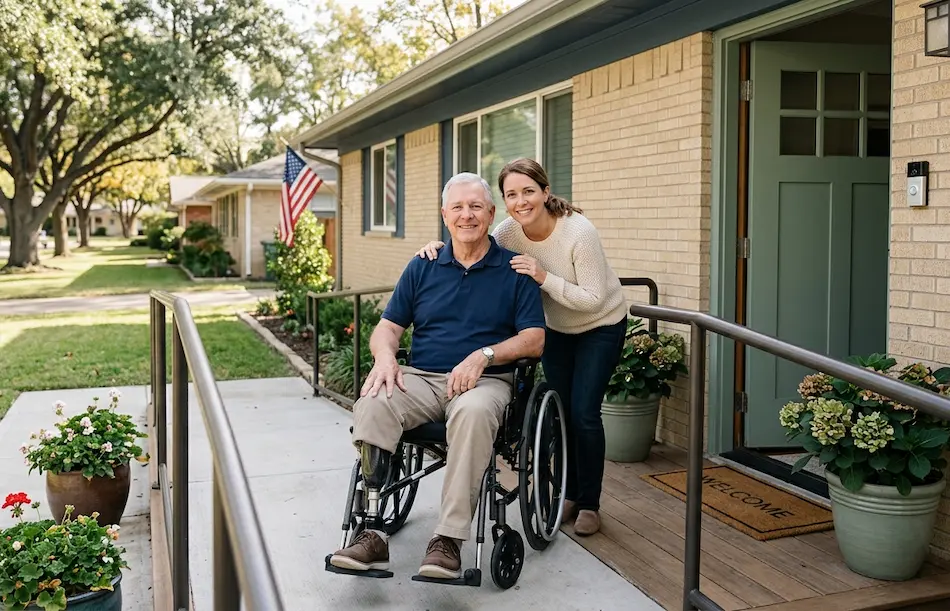
- permanent ramping for access,
- access to lavatory and sanitary facilities such as roll-in showers,
- access to kitchen or bathroom sinks or counters,
- entrance and exit improvements,
- and certain plumbing or electrical changes tied to medical equipment.
For SAH and SHA, the exact scope will depend on the veteran’s needs and approved plan, but the larger theme is adapting the home for accessibility, safe use, and independence. Rhinovations’ VA adaptation service pages reinforce that real-world scope with examples such as safer layouts, mobility-focused changes, and customized accessibility work. Their process also emphasizes assessment, proposal creation, approvals, and final inspection, which makes a good reminder for readers: grant eligibility is not the end of the process, it is the start of a properly planned one.
Just as important, the VA also lists things HISA does not pay for, including exterior decking, spas or hot tubs, home security systems, some removable equipment or appliances such as portable ramps, porch lifts, stair glides, and routine home maintenance like replacing roofs, furnaces, or air conditioners.
How to Choose the Right Grant Without Guessing
Here’s the framework I’d use.
If your disability is one of the VA’s major service-connected categories and this is your permanent home
Start by checking SAH first. It is generally the strongest fit for larger permanent-home adaptation cases.
If your disability lines up with SHA rather than SAH
Look at SHA next, especially if the permanent home is owned by you or a family member.
If you are staying with family for now
Look at TRA, but only after confirming you qualify under SAH or SHA first.
If the need is medically necessary home improvement rather than a full adapted-housing path
Look at HISA, especially if the project is centered on access, bathroom functionality, counters, ramps, or related medically necessary changes.
If I had to put it even more simply:
SAH/SHA answer “What adapted housing path fits my disability and home situation?”
HISA answers “What medically necessary modifications can help me function safely in my primary residence?”
How to Apply for a VA Housing Grant
For SAH and SHA, the VA says veterans can apply online, by mail, or in person, and the relevant form is VA Form 26-4555. The VA’s application page and form page both point to that form for adapted housing grant applications.
For HISA, the application package is different. The VA says a completed package includes a prescription written or approved by a VA physician, a completed VA Form 10-0103, and additional supporting documents such as cost estimates. If the veteran is renting, the VA also requires a signed and notarized statement from the owner authorizing the alteration.
From the project side, this is where planning matters. Rhinovations describes its own VA adaptation workflow as starting with an initial consultation, then proposal creation, document approval, VA review, job preparation, project phases, and final inspection. Whether a reader uses Rhinovations or another contractor, that sequence is a smart reality check: adaptations move more smoothly when the scope, paperwork, and construction plan are aligned early.
Common Mistakes Veterans Make When Comparing VA Housing Grants
One mistake is assuming every grant works the same way. It doesn’t.
Another is focusing only on the grant name without looking at the homeownership rule. That can quickly point you toward or away from SAH, SHA, or TRA.
A third mistake is assuming HISA is just a smaller SAH grant. It is not. HISA has its own medical-necessity framework, its own exclusions, and its own application path.
And finally, a lot of people underestimate how much the actual project scope matters. Rhinovations’ recent content says they write from a contractor’s perspective about what goes right and wrong on VA-tied projects. That is a useful mindset here: the best grant match is the one that fits both the veteran’s eligibility and the real construction scope.
When to Talk to a VA Representative or Home Adaptation Specialist
If you already know the disability category but you are unsure about the home setup, talk to the VA.
If you know the home needs changes but you are unsure whether the project belongs under SAH, SHA, TRA, or HISA, talk to both the VA and a contractor who understands adaptation work.
And if the project involves bathrooms, ramps, door clearances, kitchen access, or long-term mobility changes, it helps to bring in a specialist early. Rhinovations’ VA pages are clearly built around that kind of accessibility-focused planning and execution, which is exactly the kind of practical support many veterans need once they move from eligibility questions to real decisions.
Final Takeaway
If you’re asking which VA housing grant you qualify for, the answer usually comes down to this:
- SAH for certain severe service-connected disabilities affecting a permanent home you own or will own.
- SHA for a narrower set of qualifying service-connected disabilities in a permanent home you or a family member own or will own.
- TRA if you already qualify for SAH or SHA and are temporarily living in a family member’s home.
- HISA if you need medically necessary home improvements or structural alterations in your primary residence.
The best next step is not guessing. It is matching the disability category, the home situation, and the actual adaptation scope before you apply. That is the difference between reading about grants and choosing the right one.
FAQs
Yes. The VA says eligible veterans can use money from an SAH or SHA grant up to 6 different times over their lifetime, up to the total allowed amount.
Possibly. The VA says TRA may be available if you are living temporarily in a family member’s home that needs changes and you already qualify for SAH or SHA.
Yes, the VA lists permanent ramping, access to lavatory and sanitary facilities, and improved access to kitchen or bathroom sinks or counters among covered HISA examples.
No. The VA lists exclusions such as exterior decking, spas or hot tubs, home security systems, some removable equipment or appliances like portable ramps, porch lifts, stair glides, and routine home maintenance.
For SAH/SHA, the VA points to VA Form 26-4555. For HISA, the VA requires VA Form 10-0103 as part of the application package.