


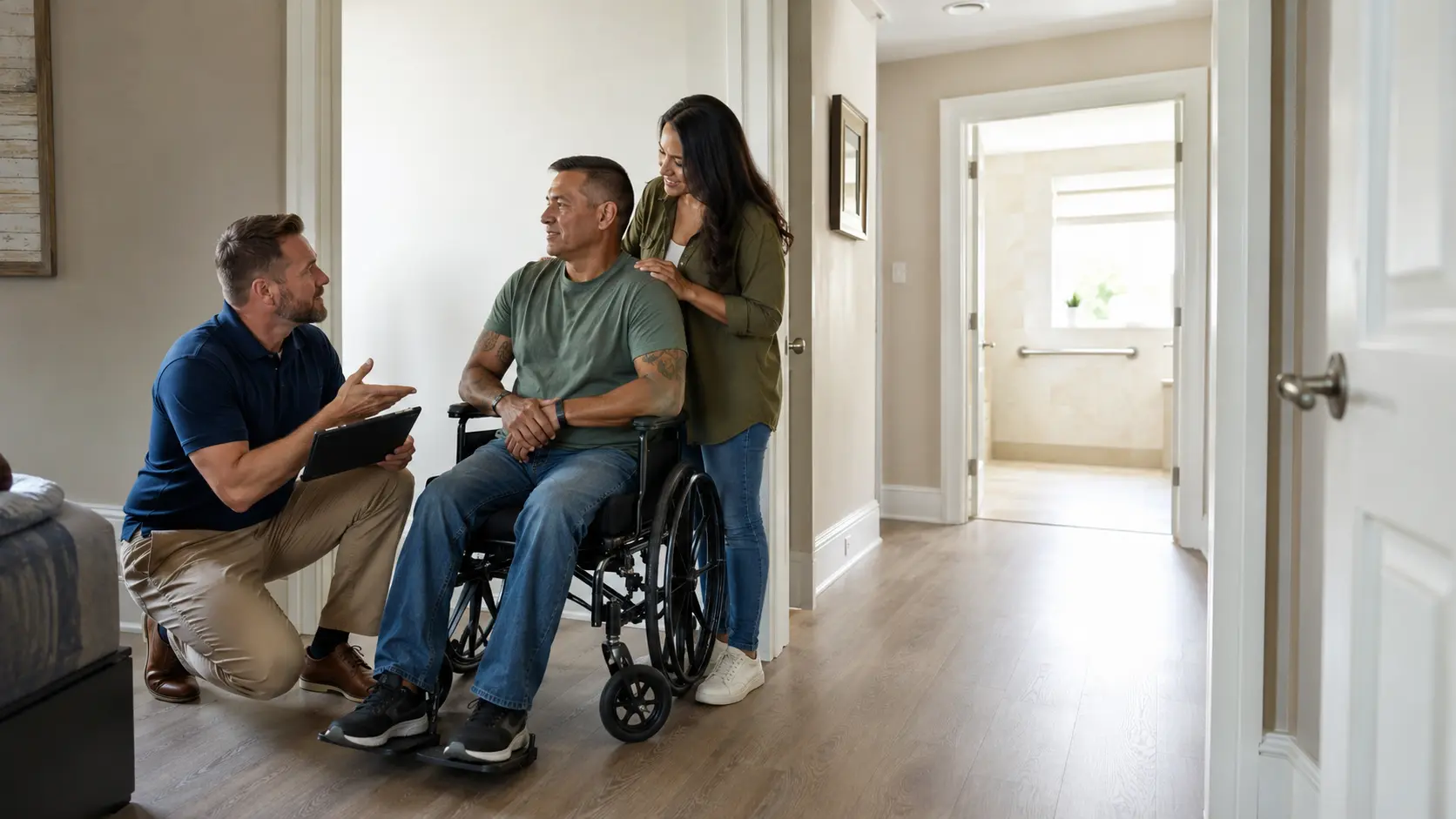
A veteran’s home should support daily independence, not create additional barriers.
For veterans with service-connected disabilities, activities such as entering the home, bathing, preparing meals, opening doors, or moving between rooms can become difficult or unsafe. VA Independent Living home modifications may help address some of these challenges.
Through the Independent Living track of Veteran Readiness and Employment, also known as VR&E or Chapter 31, eligible veterans may receive services designed to improve their ability to complete daily activities and live more independently.
Depending on the veteran’s approved rehabilitation plan, services may include an evaluation for home adaptations, accessibility equipment, counseling, and guidance about other VA programs such as HISA, SAH, SHA, or TRA.
However, Independent Living is not a general remodeling grant. The VA determines eligibility, which modifications are necessary, and what services may be included in the veteran’s plan.
What Is the VA Independent Living Track?
The Independent Living track is part of the VA’s Veteran Readiness and Employment program.
It is generally intended for eligible veterans whose service-connected disabilities affect their daily activities and currently prevent them from preparing for, seeking, or returning to suitable employment.
Independent Living services may help veterans improve their ability to:
- Bathe and dress safely
- Enter and exit the home
- Move between essential rooms
- Prepare meals
- Operate doors, faucets, switches, and controls
- Participate in family and community life
- Use mobility or adaptive equipment inside the home
Services are based on an individualized rehabilitation plan developed with a Vocational Rehabilitation Counselor.
Who May Qualify?
A veteran may be considered for Independent Living services when:
- The veteran is eligible for VR&E benefits
- A service-connected disability creates a serious employment handicap
- The disability currently prevents the veteran from returning to suitable employment
- Independent Living services are needed to improve daily functioning
Veterans are generally eligible to apply for VR&E when they did not receive a dishonorable discharge and have a VA service-connected disability rating of at least 10%.
Applying does not automatically guarantee entitlement to Independent Living services or home modifications. A VA counselor must evaluate the veteran’s disability, employment limitations, daily needs, and rehabilitation goals.
Are Independent Living Home Modifications a Separate Grant?
Not exactly.
Independent Living is a broader rehabilitation track rather than a standard home remodeling grant. A home adaptation may be included when the VA determines that it is necessary to help the veteran achieve greater independence.
The VA may also help the veteran determine whether another program is more appropriate, including:
- HISA
- Specially Adapted Housing, or SAH
- Special Home Adaptation, or SHA
- Temporary Residence Adaptation, or TRA
These benefits have different disability, medical, ownership, and approval requirements.
A contractor can evaluate the property and prepare an estimate, but only the VA can determine which program applies and whether the proposed work is authorized.
Common VA Independent Living Home Modifications
The correct modifications depend on the veteran’s mobility, strength, balance, reach, vision, caregiver needs, and home layout.
Accessible Entrances
Entrance modifications may help a veteran enter and leave the home safely.
Possible improvements include:
- Permanent wheelchair ramps
- Level landings
- Handrails
- Wider exterior doors
- Reduced thresholds
- Improved exterior lighting
- Safer access from the driveway or garage
- Platform lifts when appropriate
The design must account for slope, drainage, turning space, weather exposure, and the veteran’s mobility equipment.
Wider Doorways and Hallways
Narrow openings can prevent safe movement with a wheelchair, walker, prosthetic device, or caregiver.
Potential modifications include:
- Widening doorways
- Expanding narrow hallways
- Changing door swing direction
- Installing pocket or sliding doors
- Replacing round knobs with lever handles
- Removing raised flooring transitions
The approach to the doorway is just as important as the opening itself. Furniture, cabinets, and nearby walls should not interfere with movement.
Accessible Bathroom Modifications
Bathrooms are one of the most common areas requiring adaptation because they combine water, hard surfaces, transfers, and limited space.
Possible improvements include:
- Roll-in or barrier-free showers
- Tub removal
- Wider shower entrances
- Slip-resistant flooring
- Grab bars with structural reinforcement
- Handheld showerheads
- Accessible water controls
- Fold-down shower seats
- Improved toilet transfer space
- Roll-under or wall-mounted sinks
- Wider bathroom doors
- Better lighting and ventilation
The bathroom should be designed around how the veteran actually bathes, transfers, and moves through the room.
Accessible Kitchens
Traditional kitchens may place counters, appliances, sinks, and storage outside the veteran’s safe reach.
Potential kitchen adaptations include:
- Lower or adjustable countertops
- Roll-under sinks
- Pull-out shelves
- Accessible cabinets
- Lever-style faucets
- Reachable appliance controls
- Improved wheelchair circulation
- Accessible switches and outlets
- Better task lighting
The entire cooking process should be considered. Lowering one countertop provides limited benefit if the veteran still cannot reach the sink, refrigerator, cabinets, or appliances.
Flooring and Interior Movement
Loose rugs, thick carpeting, slippery surfaces, and raised transitions can increase fall risk or make wheelchair movement difficult.
Possible improvements include:
- Slip-resistant flooring
- Removal of loose rugs
- Smoother transitions between rooms
- Replacement of thick carpeting
- Repair of uneven flooring
- Clear accessible routes through the home
- Additional wheelchair maneuvering space
Flooring should provide traction without making wheelchair movement unnecessarily difficult.
Accessible Controls and Hardware
Smaller modifications can also improve independence.
These may include:
- Lever-style door handles
- Accessible cabinet pulls
- Rocker light switches
- Reachable thermostats
- Touchless faucets
- Lowered controls
- Automatic door openers
- Voice-controlled lighting
- Smart home features
Technology should be reliable and simple enough for the veteran to operate independently.
How Is the Home Evaluated?
A successful modification project begins with an evaluation of the veteran and the property.
The assessment may consider:
- Daily activities that are difficult or unsafe
- Mobility equipment
- Transfer methods
- Balance and fall risk
- Reach and upper-body strength
- Caregiver assistance
- Doorway and hallway dimensions
- Bathroom and kitchen layouts
- Emergency exits
- Existing plumbing and electrical systems
- Structural conditions
- Potential future needs
The goal is not to add as many accessibility features as possible. It is to identify the barriers that most directly affect the veteran’s safety and independence.
Independent Living vs. Other VA Programs
Several VA programs may support home accessibility, but they work differently.
HISA
Home Improvements and Structural Alterations, or HISA, is a VA health care benefit for medically necessary modifications to a veteran’s primary residence.
Possible uses include:
- Roll-in showers
- Accessible bathroom improvements
- Permanent ramps
- Lowered sinks or counters
- Entrance and exit modifications
- Plumbing or electrical work needed for medical equipment
HISA may be used in an owned or rented primary residence, although renters need authorization from the property owner.
SAH
The Specially Adapted Housing grant supports eligible veterans with certain severe service-connected disabilities.
It may help an eligible veteran buy, build, or substantially modify a permanent home that the veteran owns or plans to own.
SAH is commonly associated with larger projects involving several parts of the home, such as entrances, bathrooms, kitchens, doorways, and accessible routes.
SHA
The Special Home Adaptation grant serves veterans with a different group of qualifying service-connected disabilities.
For SHA, the veteran or a family member may own or plan to own the permanent home.
It may support approved adaptations such as accessible bathrooms, widened doors, controls, and other disability-related improvements.
TRA
The Temporary Residence Adaptation grant may help a veteran who qualifies for SAH or SHA modify a family member’s home where the veteran is temporarily living.
The veteran does not have to own the temporary residence but must already qualify for SAH or SHA.
Can Veterans Use More Than One Program?
A veteran may potentially qualify for more than one type of VA assistance. However, eligibility for one program does not automatically establish eligibility for another.
Veterans should confirm:
- Which program applies to each modification
- Whether benefits can be coordinated
- Which costs have been approved
- What documents are required
- Whether estimates or construction plans must be submitted
- When construction may begin
- How payments and inspections will be handled
The same expense should not be assumed to qualify for payment through multiple programs.
How to Apply for Independent Living Services
The process generally begins with an application for VR&E benefits.
1. Apply for VR&E
Veterans can apply for Chapter 31 benefits through the VA.
2. Complete the Initial Evaluation
A Vocational Rehabilitation Counselor reviews the veteran’s disability, employment limitations, independent-living needs, and goals.
3. Determine the Appropriate Track
The counselor determines whether the veteran qualifies for the Independent Living track or another VR&E service.
4. Develop a Rehabilitation Plan
When approved, the veteran and counselor identify the services needed to support greater independence.
5. Evaluate the Home
The VA may evaluate home barriers and determine whether adaptations or another housing program should be considered.
6. Obtain Estimates
An accessibility contractor may inspect the home and prepare an itemized proposal.
7. Wait for Authorization
Veterans should not begin VA-funded work until the scope, costs, and construction process have been approved.
Choosing an Accessibility Contractor
Accessibility remodeling requires more planning than a standard cosmetic renovation.
Before hiring a contractor, ask:
- Have you completed veteran accessibility projects?
- How will you evaluate the veteran’s daily routine?
- Is the estimate fully itemized?
- Are permits and inspections included?
- How will grab bars and seats be reinforced?
- What waterproofing system will be used?
- How will wheelchair clearances be verified?
- How are unexpected conditions handled?
- What warranty is included?
- What documentation will be provided?
The contractor should design around the veteran’s approved needs rather than recommending a generic accessibility package.
Common Mistakes to Avoid
Treating Independent Living as a General Remodeling Program
The program focuses on disability-related barriers and rehabilitation goals, not cosmetic home improvements.
Beginning Construction Too Early
Submitting an application or receiving an estimate does not mean construction has been approved.
Evaluating Only One Feature
A roll-in shower provides limited benefit if the veteran cannot enter the bathroom or maneuver around the toilet and sink.
Ignoring Caregiver Space
Some layouts must provide room for a caregiver to assist with bathing, transfers, meals, or medical equipment.
Assuming Every VA Program Has the Same Rules
VR&E, HISA, SAH, SHA, and TRA have different requirements.
Selecting a Contractor Based Only on Price
Accessibility projects require attention to layout, dimensions, reinforcement, waterproofing, controls, and long-term usability.
Frequently Asked Questions
They are disability-related adaptations that may be evaluated or included as part of an approved VR&E Independent Living rehabilitation plan.
No. The veteran must meet VR&E and Independent Living eligibility requirements and receive approval from the VA.
Potentially. A bathroom adaptation may be considered when it addresses an approved disability-related barrier. HISA, SAH, or SHA may also apply.
Potentially. Ramps, widened doors, and entrance modifications may be considered when they support the veteran’s approved independent-living needs.
No. A contractor can evaluate the home and prepare an estimate, but only the VA determines eligibility and approves the project.
No. Veterans should wait for VA authorization before starting grant-funded or program-funded work.
VA Independent Living Home Modifications: Final Takeaway
VA Independent Living home modifications may help eligible veterans reduce barriers and complete essential daily activities more safely.
Potential improvements include:
- Accessible entrances and ramps
- Wider doors and hallways
- Roll-in showers
- Grab bars
- Accessible sinks and counters
- Safer flooring
- Modified controls
- Kitchen adaptations
- Improved wheelchair maneuvering space
The correct benefit depends on the veteran’s disability, rehabilitation needs, home ownership, medical requirements, and living situation.
Before beginning construction, veterans should apply through the VA, work with their counselor or representative, confirm which program applies, and obtain approval for the proposed project.
Rhinovations helps veterans and families throughout Greater Houston evaluate accessibility barriers and develop practical home modification plans. Our team can inspect the property, discuss the veteran’s daily needs, and prepare a detailed remodeling proposal for the appropriate approval process.
Contact Rhinovations to schedule an in-home accessibility evaluation and begin planning a safer, more functional home.