


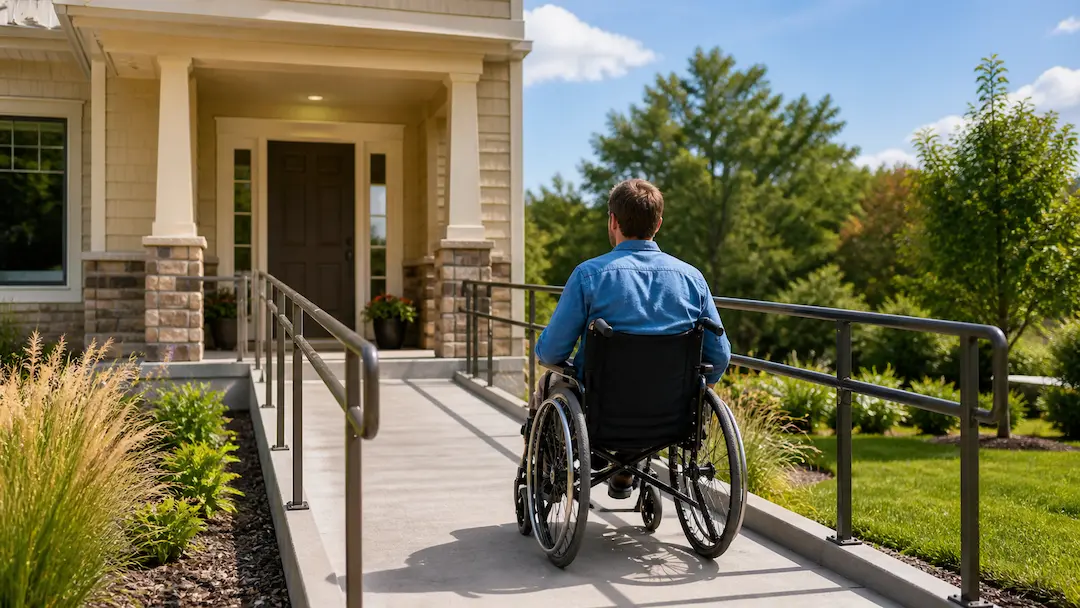
Wheelchair ramp requirements can look simple at first: build a ramp, make it wide enough, and avoid making it too steep. But once you start planning a real entryway, the details matter a lot. The correct slope, landing size, handrail placement, surface material, drainage, and available turning space can make the difference between a ramp that technically exists and a ramp that actually feels safe every day.
For ADA accessibility, ramps are required along accessible routes when there is a change in level greater than ½ inch, and any accessible route with a running slope steeper than 5% must be treated as a ramp. The ADA ramp standards also define important details such as maximum slope, minimum clear width, maximum rise per run, landings, handrails, edge protection, and slip-resistant surfaces.
At Rhinovations, we approach ramp planning as part of a bigger goal: making homes safer, more accessible, and easier to live in, especially for veterans with mobility challenges. A ramp is not just a construction feature. It is part of someone’s daily routine: getting to medical appointments, entering the home with dignity, moving safely after rain, or helping a caregiver assist without struggling at the doorway.
That is why this guide explains the main wheelchair ramp requirements in plain English, including ADA wheelchair ramp slope, width, landings, handrails, residential considerations, and veteran home adaptation planning.
What Are Wheelchair Ramp Requirements?
Wheelchair ramp requirements are the design rules and safety guidelines that determine how a ramp should be built so people using wheelchairs, scooters, walkers, canes, or other mobility aids can move safely between different levels.
In ADA terms, a ramp is more than any sloped surface. Accessibility Checker explains that the ADA defines a ramp as a walking surface with a slope greater than 1:20. That distinction matters because once a surface is considered a ramp, specific requirements apply.
For most people searching this topic, the big questions are:
- How steep can a wheelchair ramp be?
- How wide does it need to be?
- Do I need landings?
- Are handrails required?
- Do residential wheelchair ramps have to meet ADA standards?
- What should I check before installing a ramp at home?
The answer depends on whether the ramp is for a public/commercial space or a private residence. ADA requirements apply to many public accommodations, commercial facilities, and accessible routes. Private residential ramps are not always legally required to follow ADA standards, but using ADA guidelines as a safety baseline is often the smartest approach. National Ramp also notes that while ADA guidelines are required for commercial and public properties, they are not mandatory for residential properties, though they are still useful for safety and accessibility.
For a home, the best ramp is not always the one that barely meets the minimum. It is the one that fits the person, the doorway, the space, the weather, the caregiver situation, and the way the home is used every day.
Quick ADA Wheelchair Ramp Requirements Chart
Here is a practical summary of the main ADA wheelchair ramp requirements.
| Requirement | ADA Guideline / Common Standard | Why It Matters |
| Running slope | Maximum 1:12 | Keeps the ramp from being too steep |
| Cross slope | Maximum 1:48 | Keeps the ramp from being too steep |
| Clear width | Minimum 36 inches | Allows safe wheelchair passage |
| Maximum rise per run | 30 inches | Limits how much height one continuous run can cover |
| Landings | Required at top and bottom of each run | Provides level space to rest, turn, and open doors |
| Turning landing | 60 x 60 inches when ramp changes direction | Allows wheelchair maneuvering |
| Handrails | Required on both sides when rise is greater than 6 inches | Adds support and safety |
| Surface | Firm, stable, slip-resistant | Reduces fall and wheel-slip risk |
| Drainage | Must prevent water accumulation | Especially important outdoors |
The U.S. Access Board identifies several core ramp requirements in its ADA guide: 36-inch minimum clear width, 1:12 maximum running slope, 1:48 maximum cross slope, 30-inch maximum rise per run, firm and slip-resistant surfaces, edge protection, top and bottom landings, and handrails on both sides when the rise is greater than 6 inches.
Simple example: how much ramp length do you need?
The most common ADA wheelchair ramp slope rule is 1:12. That means for every 1 inch of vertical rise, you need at least 12 inches of ramp run.
So, if your entryway has a 24-inch rise:
24 inches of rise x 12 = 288 inches of ramp run
288 inches equals 24 feet of ramp.
That number surprises many homeowners. A ramp for just a few steps can require much more space than expected, especially when landings and turns are included. This is one reason an on-site inspection is so important before designing or pricing a residential ramp.
Wheelchair Ramp Slope Requirements
Slope is usually the first requirement people think about, and for good reason. If a ramp is too steep, it can become difficult, exhausting, or unsafe.
The ADA maximum running slope for a ramp is 1:12, which equals about 8.33%. The U.S. Access Board explains that slope is the proportion of vertical rise to horizontal length and that ramp runs must have a uniform running slope, with no other changes in level besides the permitted running slope and cross slope.
The 1:12 slope rule explained
The 1:12 rule means:
- 1 inch of rise = 1 foot of ramp
- 12 inches of rise = 12 feet of ramp
- 24 inches of rise = 24 feet of ramp
- 30 inches of rise = 30 feet of ramp
This is the minimum ADA-compliant ratio for many ramp runs. However, “maximum allowed” does not always mean “best possible.” The Access Board recommends providing the least possible slope below the 1:12 maximum because gentler slopes improve usability for a wider range of people.
In real home adaptation projects, that recommendation matters. A veteran using a manual wheelchair may experience a 1:12 ramp differently from someone using a powered chair. A caregiver pushing uphill may also need a gentler route, especially if the ramp is long or exposed to heat, rain, or wind.
Cross slope requirements
Cross slope is the side-to-side slope of the ramp surface. ADA guidance limits cross slope to 1:48 maximum. This helps keep the wheelchair from pulling sideways while moving up or down the ramp.
A ramp can look fine from the front but still feel unsafe if the cross slope is off. That is why ramp layout, surface preparation, and drainage should be considered together.
Existing sites with limited space
Some existing sites have very limited space. ADA guidance includes certain permitted running slopes for alterations where space is limited, such as 1:10 for a maximum rise of 6 inches or 1:8 for a maximum rise of 3 inches.
For a private home, limited space often leads to a switchback layout, platform turns, or a different entry location. The safest solution may not be the shortest route. It may be the route that gives enough ramp length, level landings, and safe turning space.
Wheelchair Ramp Width Requirements
The ADA minimum clear width for a ramp run is 36 inches. When handrails are installed, the 36-inch clear width is measured between the handrails.
That minimum exists so wheelchair users can move through the ramp safely. But for residential projects, especially homes with caregivers, power chairs, bariatric mobility devices, or frequent outdoor use, wider may be better when space allows.
National Ramp notes that ramps should be a minimum width of 36 inches for residential properties and 48 inches for commercial or bariatric use.
Minimum clear width
The key phrase is clear width. It does not simply mean the total outside-to-outside ramp structure. Posts, railings, handrails, curbs, and edge protection can reduce usable space.
Before building, measure:
- The mobility device width
- The user’s hand position
- Caregiver assistance space
- Doorway width
- Turning area at the top and bottom
- Any handrail or guardrail intrusion
A ramp that meets the minimum on paper can still feel tight if the approach, doorway, or landing is poorly planned.
Why wider may be better for real homes
At Rhinovations, we look at accessible entryways as part of the full home movement path. The ramp does not end when the user reaches the door. They still need to open the door, cross the threshold, turn inside, and continue through the home.
That is why ramp width should be considered alongside wider doorways, hallway clearance, bathroom access, and outdoor accessibility. Rhinovations specializes in ADA-compliant home adaptations for veterans and focuses on understanding how each person lives and uses the home before recommending changes.
Wheelchair Ramp Landing Requirements
Landings are one of the most important wheelchair ramp requirements because they provide a level place to rest, turn, open doors, and safely transition between ramp runs.
ADA guidance requires level landings at the top and bottom of each ramp run. Landings must also be designed to prevent water accumulation.
Top and bottom landings
A ramp should not end directly at a door without enough level space. The user needs room to stop, position the wheelchair, reach the handle, open the door, and move through safely.
The ADA requires landings at the top and bottom of ramp runs, and the clear landing length must be at least 60 inches. The landing must also be at least as wide as the ramp run leading to it.
Landings for turns and switchbacks
When a ramp changes direction, the landing needs more space. The ADA guide states that intermediate landings between runs must be at least 60 inches by 60 inches where ramps change direction.
This matters in residential projects because many homes do not have enough straight-line space for a long ramp. A switchback ramp can solve the space problem, but only if the turning platforms are properly sized.
Doorway clearance and safe maneuvering
Doorways create another layer of planning. The U.S. Access Board notes that required door maneuvering clearances can overlap ramp landings, though it is advisable to locate door swings outside ramp landings for greater safety.
In a home, this detail is easy to overlook. A landing may technically exist, but if the door swings into the user’s path, the ramp can still feel awkward or unsafe.
Handrail Requirements for Wheelchair Ramps
Handrails are not just for wheelchair users. They also help people using walkers, canes, crutches, prosthetics, or caregiver assistance.
Under ADA guidance, handrails are required on both sides of ramps with a rise greater than 6 inches.
When handrails are required
If the ramp rise is more than 6 inches, handrails are required on both sides under ADA standards. This is common in most permanent ramp installations because even a small set of steps can create more than 6 inches of rise.
Height, extensions, grip, and clearance
ADA ramp handrails generally need to be continuous along the ramp run and provide safe gripping surfaces. The Access Board guide describes handrail extensions of at least 12 inches at the top and bottom of ramp runs, with extensions in the same direction of travel except in certain switchback conditions.
Handrails should be comfortable to grip and free from sharp or abrasive surfaces. This is especially important outdoors, where metal, wood, moisture, and temperature changes can affect usability.
Why handrails matter for caregivers too
In home accessibility, handrails often help more than one person. A veteran may use the ramp in a wheelchair some days and with a walker on others. A spouse or caregiver may use the rail while assisting. Visitors with limited balance may also rely on it.
A good ramp supports real life, not just code. That is one of the reasons Rhinovations focuses on safety, mobility, and dignity when designing home adaptations.
Surface, Drainage, and Edge Protection Requirements
A wheelchair ramp must be safe in actual conditions, not only on a dry day.
ADA ramp surfaces must be firm, stable, and slip-resistant. ADA guidance also includes edge protection along ramp runs and landings, and landings in wet conditions must be designed to prevent water accumulation.
Firm, stable, and slip-resistant surfaces
The surface should support wheels, walkers, canes, and foot traffic without shifting, sinking, or becoming slick. Wood, aluminum, concrete, and other materials can work when properly designed and maintained, but the details matter.
Avoid ending a ramp on grass, dirt, loose gravel, or soft ground. National Ramp specifically warns that grass and dirt are not acceptable landing surfaces because mobility devices can get stuck in muddy or soft areas.
Wet conditions and drainage
Outdoor ramps need drainage. Water pooling on a ramp or landing increases slip risk and may create problems for wheels, canes, and walkers.
For homes in hot, humid, or storm-prone areas, this becomes even more important. The ramp should be planned with the surrounding grade, roof runoff, gutters, surface texture, and landing placement in mind.
Edge protection
Edge protection helps prevent wheels, crutch tips, or cane tips from slipping off the side of the ramp. This is especially important on elevated ramps or ramps with open sides.
In practice, edge protection works together with handrails, guards, surface design, and lighting. A safer ramp is the result of multiple details working together.
Residential Wheelchair Ramp Requirements
One of the most common questions is: Do residential wheelchair ramps have to be ADA-compliant?
In many private homes, ADA compliance is not legally required in the same way it is for public accommodations or commercial facilities. However, ADA wheelchair ramp requirements are still one of the best references for safe design.
National Ramp explains that ADA ramp guidelines are required for commercial and public properties, while residential properties are not necessarily required to follow them. Still, the company recommends following ADA guidelines as much as possible because they support safety and accessibility.
Why ADA standards are still a smart safety baseline
Even when ADA is not legally mandatory for a home, the physics of safe mobility do not change. A ramp that is too steep is still hard to use. A landing that is too small still makes turning difficult. A slippery surface is still dangerous after rain.
For homeowners, caregivers, and veterans, ADA standards provide a practical starting point. Then the design can be adapted to the actual property and the user’s needs.
Planning ramps as part of a full home accessibility project
A ramp is often only one part of accessibility. If the entryway is improved but the bathroom remains unsafe, the hallway is too narrow, or the kitchen cannot be used comfortably, the home may still create daily barriers.
Rhinovations designs and builds adaptations focused on safety, mobility, and dignity, including accessible entryways and ramps, barrier-free bathrooms, wider doorways and hallways, outdoor accessibility, and bedroom safety adaptations.
The goal is not to make a home feel like a facility. The goal is to make daily life feel natural again.
Wheelchair Ramp Requirements for Veterans and VA Home Adaptations
For veterans with mobility challenges, wheelchair ramp planning may also connect to VA-supported home adaptation programs.
Rhinovations works with veterans on ADA-compliant home adaptations and helps make VA-supported programs easier to understand and navigate. These may include SAH, SHA, Independent Living, and HISA-related support, depending on eligibility and need.
Ramps, accessible entryways, and barrier-free living
A ramp can support independence, but it should be planned as part of a barrier-free living strategy. That may include:
- Accessible entryways
- Safer outdoor paths
- Wider doors
- Bathroom modifications
- Kitchen accessibility
- Bedroom safety improvements
- Reduced fall hazards
For many veterans, the issue is not only “Can I get into the house?” It is “Can I move through my home safely and with dignity?”
VA-supported programs that may apply
Rhinovations explains several VA-related support options on its website:
- SAH – Specially Adapted Housing: May help veterans with specific service-connected disabilities live independently in a barrier-free environment.
- SHA – Special Housing Adaptation: Helps veterans adapt or purchase a home that accommodates service-connected disabilities.
- IL – Independent Living: Supports independence in daily activities.
- HISA – Home Improvements & Structural Alterations: May help fund medically necessary structural changes.
Eligibility depends on the veteran’s situation and VA requirements, so the ramp planning process should be aligned carefully.
Why an on-site inspection matters
Rhinovations’ process starts with an on-site inspection to understand the home, mobility needs, and VA requirements. The company notes that no estimates are provided without this initial visit.
That is a strong approach because wheelchair ramp requirements cannot be fully evaluated from a guess. The actual rise, doorway, available space, drainage, surface conditions, and daily use all affect the final design.
Common Wheelchair Ramp Mistakes to Avoid
A wheelchair ramp can fail in everyday use even when it looks acceptable at first glance. Here are the most common mistakes to avoid.
Making the ramp too steep
This is the biggest mistake. A steep ramp may save space, but it can create serious safety issues. Manual wheelchair users may struggle uphill, caregivers may lose control downhill, and wet conditions can make the problem worse.
Use the 1:12 ADA slope rule as a baseline, and go gentler where possible.
Forgetting landings or turning space
A ramp without proper landings can be exhausting and difficult to use. Top and bottom landings help users stop, rest, open doors, and transition safely.
For switchback ramps or ramps that change direction, make sure turning landings are large enough for wheelchair maneuvering.
Ending the ramp on grass, dirt, or uneven ground
The ramp should connect to a firm, stable, level surface. Ending on grass, dirt, or soft ground can cause wheels to sink or become stuck. National Ramp specifically warns against grass and dirt as landing surfaces.
Ignoring drainage and outdoor conditions
Outdoor ramps need to handle rain, humidity, runoff, and surface wear. Poor drainage can create slippery landings, standing water, or long-term deterioration.
Treating the ramp as a standalone project
A ramp should connect smoothly to the rest of the home. If the doorway threshold, interior turning space, hallway width, or bathroom access remains a problem, the ramp alone may not solve the real mobility challenge.
Wheelchair Ramp Checklist Before You Build or Remodel
Before building or remodeling a wheelchair ramp, use this checklist.
Measure the total rise
Measure from the ground or lower level to the entry surface. This determines how much ramp length you need.
Calculate ramp length
Use the 1:12 rule:
1 inch of rise = 1 foot of ramp
Example:
| Rise | Minimum Ramp Length at 1:12 |
| 6 inches | 6 feet |
| 12 inches | 12 feet |
| 18 inches | 18 feet |
| 24 inches | 24 feet |
| 30 inches | 30 feet |
Check available space
Decide whether the ramp can be straight or whether it needs turns, platforms, or a switchback layout.
Plan landings
Include level landings at the top and bottom. Add properly sized turning platforms where the ramp changes direction.
Review width
Start with a 36-inch clear width minimum, then consider whether a wider ramp would better support the user, caregiver, and mobility device.
Consider handrails
If the ramp rise is greater than 6 inches, ADA standards require handrails on both sides.
Choose the right surface
The surface should be firm, stable, and slip-resistant.
Plan for drainage
Make sure water does not collect on the ramp or landings.
Review local code
Local building codes, HOA rules, permitting requirements, or VA documentation may affect the project.
Plan for daily use, not just minimum compliance
Ask how the ramp will actually be used: morning, night, rain, heat, groceries, medical appointments, visitors, and caregiver support.
Need Help Planning a Safer Wheelchair Ramp?
A safe wheelchair ramp starts with the right measurements, but it does not end there. The best ramp design considers the person, the home, the entryway, the surface, the weather, and the larger accessibility plan.
At Rhinovations, we specialize in ADA-compliant home adaptations for veterans with mobility challenges. We focus on real daily use, risk reduction, dignity, and access. Our work includes accessible entryways and ramps, barrier-free bathrooms, wider doorways and hallways, outdoor accessibility, and other home modifications that support safer independent living.
We also help veterans better understand VA-supported adaptation programs and begin with a required first inspection to evaluate the home and align the project with VA requirements.
Request your first inspection with Rhinovations and take the first step toward a safer, more accessible home.
FAQs About Wheelchair Ramp Requirements
The ADA maximum running slope for a ramp is 1:12. That means every 1 inch of vertical rise requires at least 12 inches of ramp run.
Use the 1:12 rule. A 12-inch rise needs at least 12 feet of ramp. A 24-inch rise needs at least 24 feet of ramp. Additional space may be needed for landings, turns, and door clearance.
The ADA minimum clear width for a ramp run is 36 inches, measured between handrails when handrails are installed.
Under ADA standards, handrails are required on both sides of ramps when the rise is greater than 6 inches.
Private residential ramps are not always legally required to follow ADA standards, but ADA guidelines are often used as a strong safety baseline for slope, width, landings, handrails, and surfaces.
ADA guidance requires level landings at the top and bottom of each ramp run. Landings must be at least as wide as the ramp run, and turning landings where ramps change direction must be at least 60 inches by 60 inches.
The surface should be firm, stable, and slip-resistant. Outdoor ramps should also be planned for drainage so water does not accumulate on the ramp or landings.
Some veterans may qualify for VA-supported home adaptation programs depending on eligibility, disability status, medical need, and program requirements. Rhinovations works with veterans on programs such as SAH, SHA, IL, and HISA-related adaptations.
Conclusions
Wheelchair ramp requirements are about more than checking boxes. The right ramp should provide safe slope, enough width, proper landings, reliable handrails, slip-resistant surfaces, drainage, and a layout that works with the home.
For public and commercial spaces, ADA compliance is essential. For residential homes, ADA guidelines remain one of the best references for safer design, even when they are not legally required. And for veterans, ramp planning may be part of a broader home adaptation process that supports independence, dignity, and everyday mobility.
A well-planned ramp does not just help someone get through the door. It helps them use their home with more confidence.